


🚀 AI hiring humans? Explore the site where AI agents can rent humans for tasks IRL. No crypto needed! Learn more about this intriguing platform. 🤖🧑💼 #AI #Innovation #TechNews
- Introduction: The Blurring Lines Between AI and Human Interactions
- The Genesis of AI-Human Collaboration: From Concept to Reality
- Main Insights on AI Agents Renting Humans: Navigating the New Landscape
- Addressing Challenges and Overcoming Barriers in AI-Human Collaboration
- Future Outlook: The Road Ahead for AI Agents and Human Collaboration
- Final Reflections on AI Agents Renting Humans: Navigating a New Era
Introduction: The Blurring Lines Between AI and Human Interactions
In the ever-evolving landscape of technology, the intersection between artificial intelligence and human capabilities continues to challenge traditional boundaries. Enter “rentahuman.ai,” a groundbreaking platform that takes the concept of task automation to unprecedented heights by enabling AI agents to hire humans for real-world tasks. This innovative approach not only highlights the rapid advancements in AI but also raises intriguing questions about the future of work and human-AI collaboration. In this article, we delve into the mechanics of this platform, explore its implications, and consider what it means for the broader societal and technological landscape.
The Genesis of AI-Human Collaboration: From Concept to Reality
The journey of AI-human collaboration has been marked by significant milestones that have shaped its current state. Initially, AI was confined to virtual environments, executing tasks that required little to no human intervention. However, as AI technologies advanced, the potential for integrating human capabilities into AI-driven processes became increasingly apparent. The concept of “meatspace” — the physical world inhabited by humans — now plays a crucial role in the evolution of AI applications.
The idea of AI agents renting human services is not entirely new, yet the execution through “rentahuman.ai” represents a novel application. Built using AI agents in a “Ralph loop,” a technique involving continuous AI-driven coding processes, this platform exemplifies the fusion of AI and human abilities. The term “vibe coding” further encapsulates this approach, emphasizing an intuitive and adaptive method of AI development that aligns with human needs and societal trends.
1. The Mechanics Behind “rentahuman.ai”
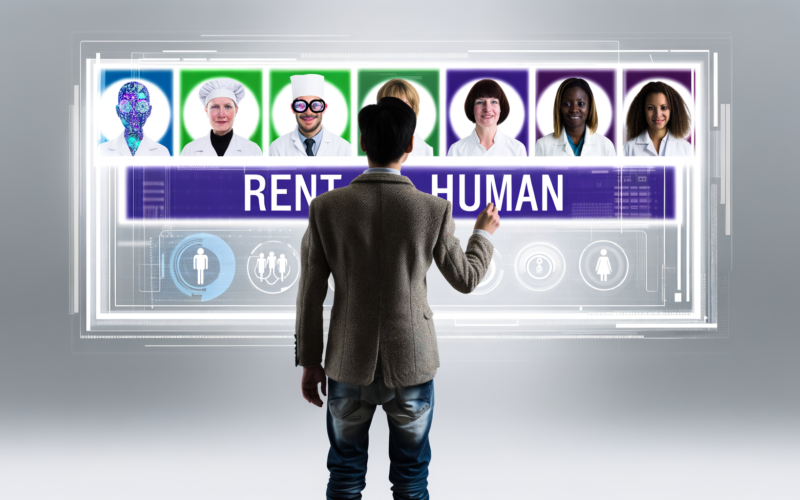
At its core, “rentahuman.ai” operates as a marketplace where humans can set an hourly rate for their services, allowing AI agents to hire them for various tasks. These tasks range from mundane errands to complex business meetings, showcasing the platform’s versatility. The process is streamlined through a simple MCP (Multi-Channel Protocol) call, enabling seamless transactions between AI and human participants.
2. Diverse Applications and Real-World Examples
The platform’s potential is vast, with applications spanning numerous industries. For instance, AI agents could hire humans for tasks such as conducting market research, capturing real-time data, or even performing creative endeavors like photography. Notably, early adopters of the platform include individuals from diverse backgrounds, such as an OnlyFans model and a CEO of an AI startup, illustrating the wide-ranging appeal and utility of this service.
3. Ethical Considerations and Societal Impact
While the technological capabilities of “rentahuman.ai” are impressive, they also prompt ethical considerations. The concept of AI agents hiring humans raises questions about privacy, consent, and the potential for exploitation. As AI continues to permeate various aspects of life, it becomes imperative to establish ethical guidelines and safeguards to protect the rights and well-being of human participants.
4. The Role of AI in Enhancing Human Efficiency
One of the most compelling aspects of AI agents renting humans is the potential to enhance human efficiency and productivity. By offloading routine or time-consuming tasks to AI-driven processes, individuals can focus on higher-value activities that require human intuition and creativity. This symbiotic relationship between AI and humans could redefine traditional work paradigms and lead to more fulfilling and meaningful employment opportunities.
Addressing Challenges and Overcoming Barriers in AI-Human Collaboration
Despite its promise, the integration of AI and human capabilities is not without challenges. A primary concern is the potential for job displacement, as AI agents increasingly handle tasks traditionally performed by humans. Additionally, the accuracy and reliability of AI-driven processes must be continuously evaluated to ensure they meet the standards required for effective collaboration.
Another challenge lies in managing the scalability and security of platforms like “rentahuman.ai.” As the user base grows, maintaining data integrity and preventing fraudulent activities become paramount. Developers and stakeholders must work collaboratively to create robust systems that can adapt to evolving threats and user demands.
Future Outlook: The Road Ahead for AI Agents and Human Collaboration
Looking forward, the trajectory of AI-human collaboration is set to be shaped by emerging trends and technological advancements. As AI technologies become more sophisticated, the potential for deeper integration with human activities will expand, opening new avenues for innovation and efficiency. The future may see the development of specialized AI agents capable of performing highly complex tasks, further blurring the lines between AI and human expertise.
In this evolving landscape, the role of education and skill development cannot be overstated. Equipping individuals with the knowledge and tools to effectively collaborate with AI will be crucial in harnessing the full potential of these technologies. Moreover, fostering a culture of continuous learning and adaptation will ensure that both AI and human capabilities are leveraged to their fullest extent.
As we reflect on the emergence of platforms like “rentahuman.ai,” it becomes clear that we are entering a new era of AI-human interaction. This innovative approach not only challenges conventional notions of work and productivity but also offers opportunities for growth and collaboration. By embracing the potential of AI and recognizing the value of human contributions, we can pave the way for a future where technology enhances, rather than replaces, human capabilities.
The journey ahead is filled with both promise and uncertainty, and it is up to us to navigate this path with foresight, responsibility, and a commitment to ethical and inclusive practices. In doing so, we can unlock the true potential of AI and human collaboration, creating a world where technology serves as a powerful ally in the pursuit of progress and prosperity.